Frederique Constant
3models
5collections
70reviews
Frederique Constant
HighAccessible "affordable luxury" with in-house manufacture calibers
Geneva, Switzerland · est. 1988
part of Citizen Group
$800–$4,000
My tier · 2
Frederique Constant is a Swiss manufacture built around a single idea: real watchmaking at reachable prices. In just over three decades it grew from an outsourced startup into a vertically integrated Geneva house with its own complicated calibers.
More about Frederique Constant
History
Frederique Constant was founded in 1988 in Geneva by the Dutch couple Peter Stas and Aletta Bax. The name joins the first names of their grandparents, Frederique Schreiner and Constant Stas. The first collection of six models reached the market in 1992, fitted with outsourced Swiss movements.
In 1994 the brand introduced the Heart Beat, a dial with an aperture revealing the oscillating balance wheel. The look was uncommon at the time and was widely copied later, becoming the house signature.
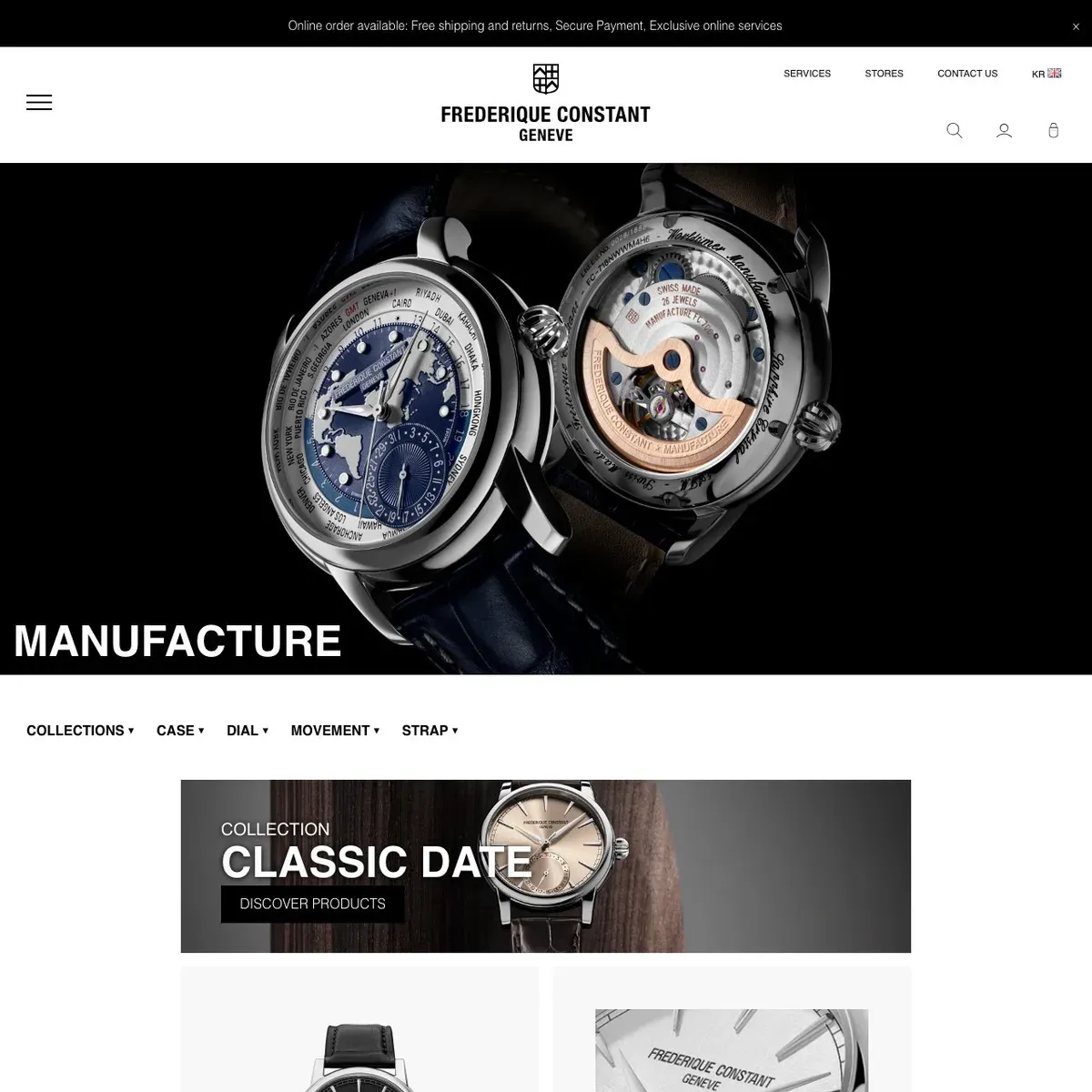
The decisive shift came in 2004 with the caliber FC-910, the first movement designed and built in house, which turned the company into a true manufacture. Technical milestones followed quickly: silicon components in 2007, a Tourbillon in 2008, the Classic Worldtimer Manufacture in 2012, and the Manufacture Perpetual Calendar in 2016.
A different kind of innovation arrived in 2015 with the Horological Smartwatch, an analog watch that quietly tracked activity and sleep. It used the MMT-285 module, built by a joint venture between Frederique Constant and the technology firm Fullpower. The piece showed the brand's appetite for experiment, even though it sat apart from its mechanical core.
In 2016 the Citizen Group of Japan acquired the Frederique Constant holding, which also owned Alpina and Ateliers deMonaco. The brand kept its Geneva base and its founders stayed on through the transition.
The Highlife collection, first seen in the early 2000s, was revived in 2020 with an integrated interchangeable bracelet, pushing the brand toward a more modern audience. In 2021 the company unveiled the Slimline Monolithic Manufacture, then marked its 35th anniversary in 2023. Today it produces roughly 120,000 watches a year and offers a range of more than 30 in house calibers.
Across this arc the brand grew from a niche startup into a recognized name in accessible Swiss watchmaking. Its reputation rests less on heritage and more on a steady record of bringing complications and innovation to reachable prices.
Accessible luxury: the founding idea
The brand's defining strategy is accessible luxury, a phrase it helped popularize. The aim was to offer genuine Swiss watchmaking, complications included, at prices far below the traditional Geneva houses.
This positioning sits in a precise gap, above fashion quartz and basic entry mechanics, yet well below the established luxury manufactures. A perpetual calendar near $11,000 captures the pitch, since comparable complications elsewhere cost several times more.
The trade off is perceived prestige. For value driven enthusiasts, though, the proposition is unusually strong.
The phrase also doubles as a discipline. Because the brand cannot lean on a famous past, it must keep justifying its prices through visible engineering and finishing. That pressure helps explain why a maker of its size invests so heavily in movement development.
Founders and ownership
Peter Stas and Aletta Bax built the company from one collection into a vertically integrated manufacture in under twenty years. Their engineering led approach, rather than borrowed heritage, shaped the brand's character.
The 2016 sale to Citizen gave Frederique Constant the scale and distribution of a major Japanese group, especially across Japan and the United States. It joined a portfolio that already included Bulova and the Swiss brand Alpina.
Citizen ownership has preserved the accessible luxury identity while funding continued movement development. The company is today led by chief executive Niels Eggerding.
Manufacture movements and the Monolithic
Frederique Constant develops, produces, and assembles its own calibers, a rarity at its price level. The FC-910 Heart Beat of 2004 opened the line, and the family now spans more than 30 movements.
The standout achievement is the Monolithic, launched in 2021 on the Slimline Monolithic Manufacture. It replaces the conventional assortment of around 26 parts with a single silicon component carrying two regulating weights.
This compliant mechanism oscillates at 40 Hz, roughly ten times faster than a standard 4 Hz movement, improving precision and resistance to shocks. Offering such an innovation near $5,000 is remarkable, since high frequency research usually lives in far costlier watches.
The Heart Beat signature
The Heart Beat remains the visual code most associated with the brand. By cutting an opening at 6 o'clock or 12 o'clock, Frederique Constant exposed the beating balance without resorting to a full skeleton dial.
When it arrived in 1994 the open dial view was unusual, and the design has since been imitated across the industry. Modern versions such as the Classics Heart Beat Manufacture pair the aperture with a moonphase and an in house movement.
The motif gives an otherwise classical dress watch a clear point of identity. It is the closest thing the brand has to an icon.
Design language and dial craft
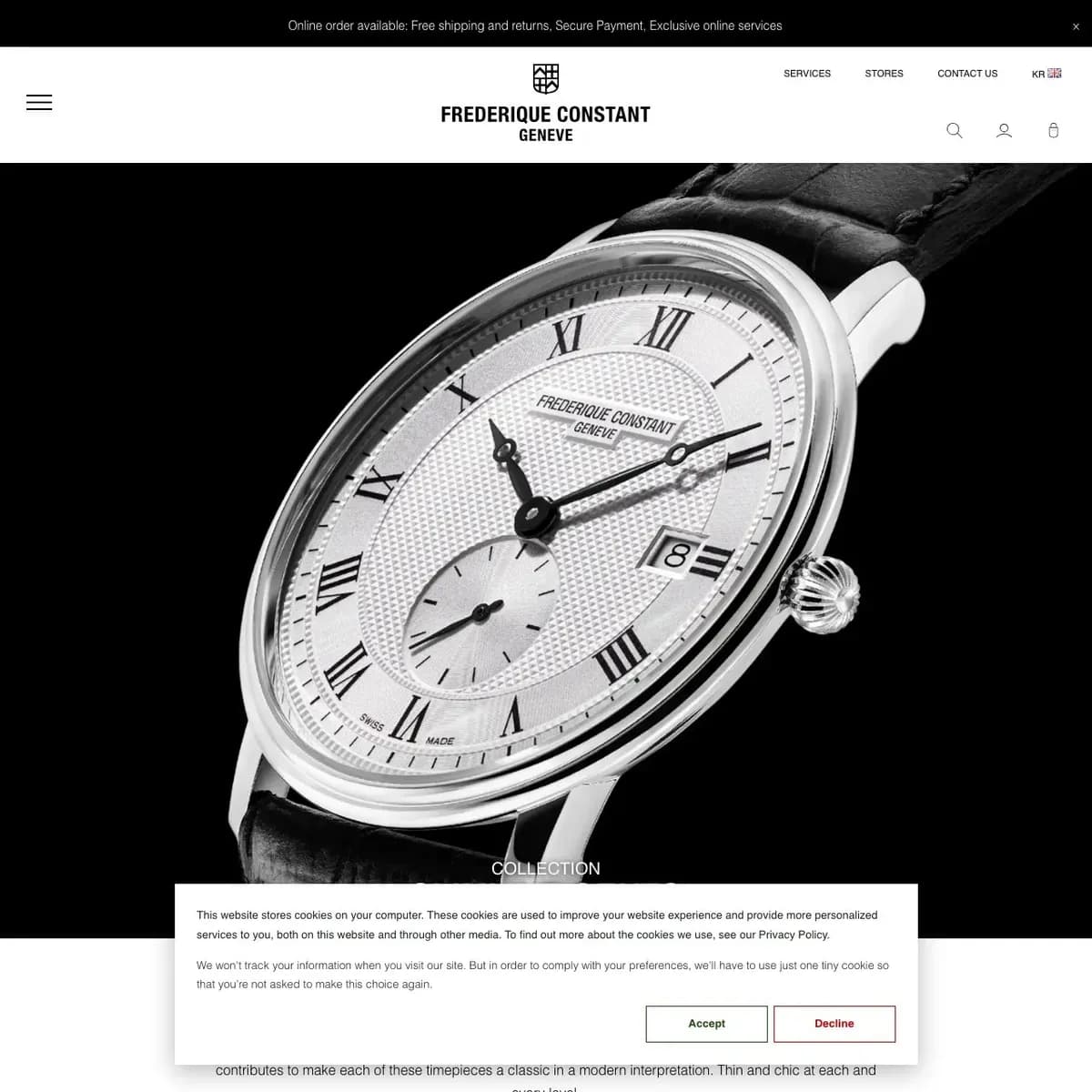
The brand's aesthetic is rooted in classical Geneva watchmaking: round cases, slim profiles, Roman numerals, and quiet dials. The look is deliberately timeless rather than fashionable.
Signature details recur across the range, including the onion shaped crown, guilloche and clous de Paris textures, and applied markers. These touches signal a level of finishing above the price.
The Heart Beat aperture is the boldest gesture, breaking an otherwise calm dial with visible mechanics. Newer lines such as the Highlife push toward a more contemporary feel, with a globe textured dial and an integrated bracelet.
The result is a catalog that reads as understated and dressy, with a small number of more expressive pieces at the top.
Model lineup
| Collection | Identity | Highlights |
|---|---|---|
| Classics | Traditional round dress watches and the entry point to the brand | Heart Beat Moonphase and Index Automatic, broadly priced around $800 to $2,000 |
| Slimline | Thin, restrained dress line with a contemporary feel | Slimline Moonphase, Slimline Perpetual Calendar, and the flagship Slimline Monolithic Manufacture |
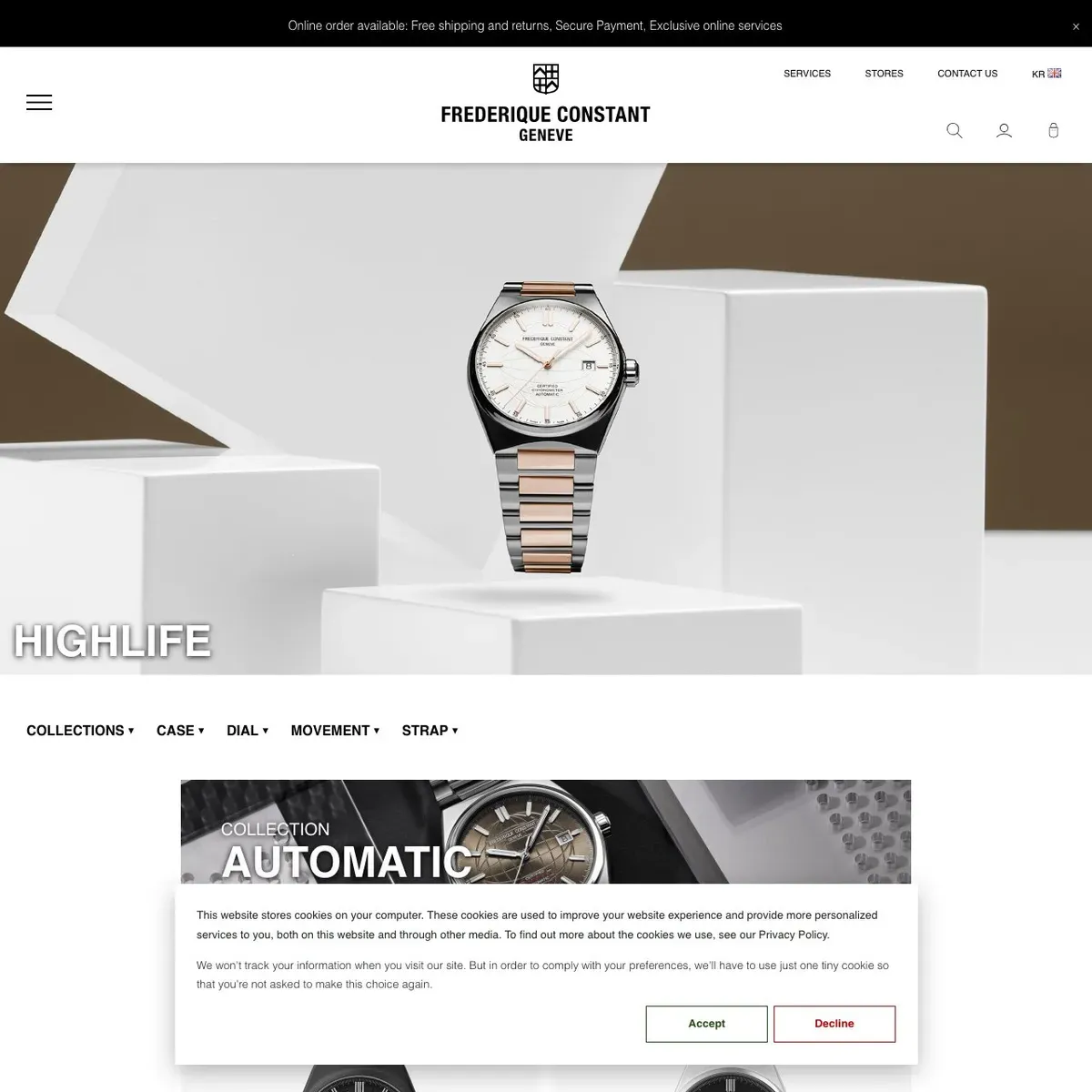
| Highlife | Integrated bracelet sports luxury line, revived in 2020 | Highlife Automatic COSC, Worldtimer Manufacture, and Perpetual Calendar Manufacture |
| Manufacture | Showcase for the in house complications | Worldtimer, Perpetual Calendar, Flyback Chronograph, and Tourbillon |
| Ladies and Art Deco | Smaller, vintage inspired and jewelry leaning pieces | Art Deco oval cases, diamond set dials, quartz and automatic options |
Notable models worth knowing
Classics Heart Beat Manufacture. The purest expression of the brand, pairing the open balance aperture with an in house automatic, often around $2,000 to $3,000.
Slimline Monolithic Manufacture. The technical flagship, showing the 40 Hz silicon oscillator through a dial aperture, priced near $5,000.
Classic Worldtimer Manufacture. An affordable world time watch with a city disc and a central world map, all adjustable by the crown.
Highlife Perpetual Calendar Manufacture. A perpetual calendar on an integrated bracelet near $11,000, undercutting most rivals by a wide margin.
Slimline Moonphase. A clean, classical dress watch with a moonphase, one of the most popular ways into the brand.
Where it fits: the competitive set
Frederique Constant lives in one of the most contested zones in watchmaking, the space roughly between $1,000 and $5,000. Here a buyer can choose among many credible Swiss and Japanese names, so identity matters as much as specification.
Its closest rivals are Longines and Tissot from the Swatch Group, both with deep heritage and strong mechanical value. Oris competes as an independent with its own movements, while Hamilton offers Swiss mechanics with American styling.
Against these, Frederique Constant leans on two arguments: true in house complications and a recognizable open dial signature. Where it tends to lose is heritage and resale, where rivals such as Longines and Oris are stronger.
The Highlife also steps into integrated bracelet territory led by the Tissot PRX and pricier icons, a fashionable but crowded field.
Why it stands out
Genuine manufacture status at low prices. Very few brands under $5,000 design and build their own complicated calibers in Geneva.
The Monolithic oscillator. A real horological innovation, the 40 Hz silicon regulator brings cutting edge research to an affordable watch.
A recognizable signature. The Heart Beat aperture gives the catalog an identity that many rivals at this level lack.
Affordable complications. Worldtimers, perpetual calendars, and tourbillons appear at a fraction of their usual cost.
Citizen backing. Group ownership provides stability, distribution, and research funding without erasing the brand's character.
Vertical integration in Geneva. Design, production, and assembly under one roof are rare at this price and support consistent quality.
A broad but coherent range. From simple quartz to perpetual calendars, the lineup covers many needs while holding a single identity.
Weaknesses
Limited resale value. Like most watches in this segment, Frederique Constant pieces depreciate sharply on the secondary market.
Soft prestige. The accessible luxury position means the name carries little of the status held by established Geneva houses.
Design conservatism. Outside the Highlife and the Monolithic, much of the range reads as safe and classical.
Crowded price territory. It competes head on with strong rivals such as Longines, Tissot, Oris, and Hamilton for the same buyers.
Modest brand awareness. Despite real watchmaking credentials, it remains less known than its technical merits deserve.
Mixed range substance. Alongside the manufacture pieces sit outsourced and quartz models that dilute the in house story.
Finishing limits. Movement decoration is strong for the money, yet it does not match traditional high luxury houses under close inspection.
Summary
Frederique Constant is one of the clearest examples of substance over status in modern watchmaking. From a standing start in 1988, the Stas couple built a vertically integrated Geneva manufacture that delivers real complications at prices most enthusiasts can reach.
Its Heart Beat dial and the Monolithic oscillator show a brand willing to innovate rather than simply discount. The 2016 Citizen acquisition reinforced this without diluting the founding idea.
The reward is exceptional value, and the cost is modest prestige and weak resale. For a buyer who cares about engineering and design more than logos, it is among the smartest entries into Swiss watchmaking.
Buying and ownership considerations
For new buyers, the value case is strongest on the Manufacture pieces, where in house complications justify the spend. Quartz and outsourced models compete more on looks than on substance.
On the secondary market the watches are inexpensive, which rewards patient buyers but punishes original owners. Expect meaningful depreciation from retail prices.
Servicing flows through the Geneva manufacture and the wider Citizen network, which aids long term support compared with smaller independents. Reliable parts supply is a genuine benefit of group ownership.
The brand suits someone who wants real watchmaking and dressy looks at a sensible outlay, rather than a status symbol or an investment.
Sister brands: Alpina and Ateliers deMonaco
Frederique Constant shares ownership with Alpina, a revived Swiss sports watch brand that draws on related movements and manufacturing. The two grew together under the Stas family before the Citizen sale.
Ateliers deMonaco sits above both as a small maker of finely finished and more complicated watches. It represents the group's reach toward traditional haute horlogerie.
Together they let the group address several price tiers from one Geneva base. Shared engineering also helps spread the cost of developing new movements.
Milestone timeline
- 1988: Brand founded in Geneva by Peter Stas and Aletta Bax.
- 1992: First collection of six models launches with outsourced movements.
- 1994: The Heart Beat open dial debuts.
- 2004: Caliber FC-910 becomes the first in house movement.
- 2007: Silicon components introduced.
- 2008: First Tourbillon.
- 2012: Classic Worldtimer Manufacture.
- 2015: Horological Smartwatch launches with analog activity tracking.
- 2016: Manufacture Perpetual Calendar arrives and Citizen Group acquires the holding.
- 2020: Highlife collection revived with an integrated interchangeable bracelet.
- 2021: Slimline Monolithic Manufacture introduces the 40 Hz oscillator.
- 2023: Brand marks its 35th anniversary.
This sequence shows a clear pattern of regular, ambitious steps that pull complications and innovation down to accessible prices.